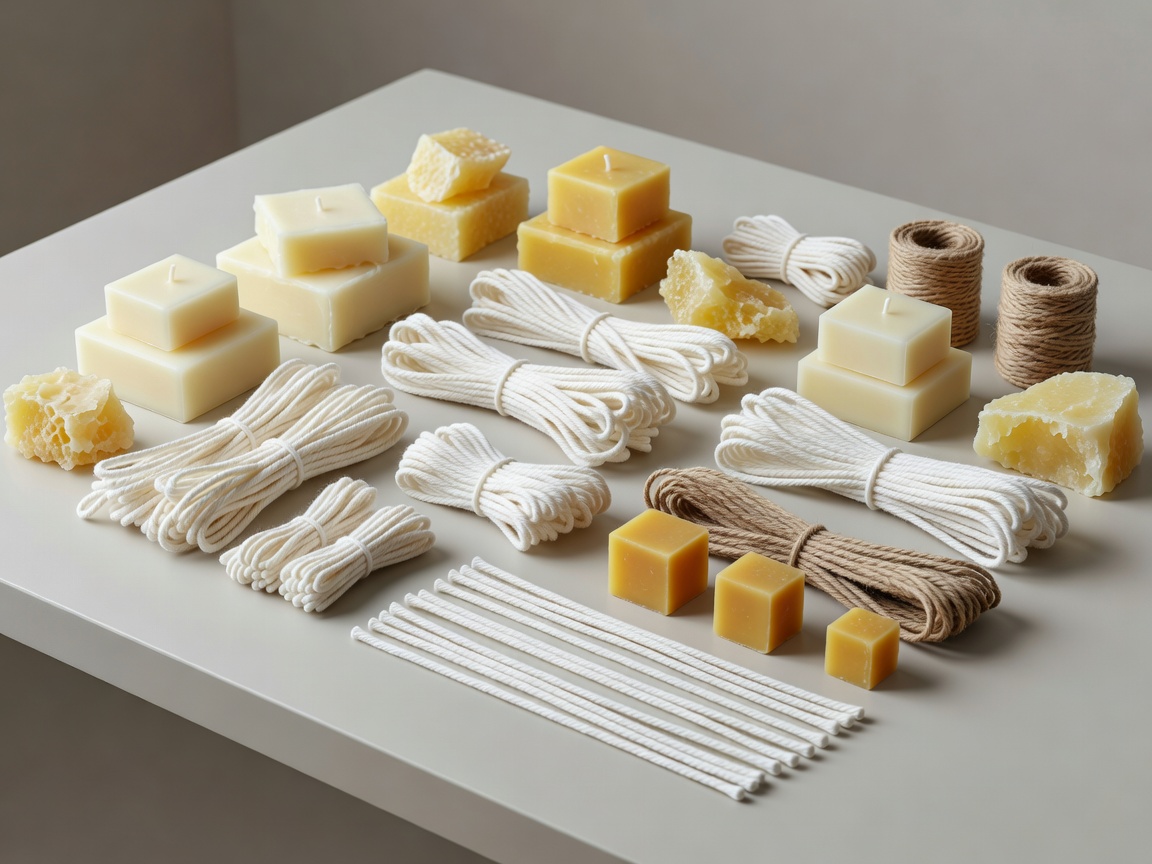
Material selection begins with the intended candle: a vessel, pillar, taper or molded object. Each form places different demands on structure and support. Wax is not interchangeable by name alone, and a wick that works in one candle may not suit another. Formulation, dimensions, vessel, fragrance, dye and testing conditions influence the result. Use supplier documentation as a starting point, then assess the complete design responsibly.
Wax families compared
Beeswax is an animal-derived wax associated with beekeeping. Its natural color and aroma vary with source and processing. It is often selected for its warm appearance and material history. Hardness, surface, scent and suitability depend on the particular wax and candle form. Natural origin does not remove the need for wick selection, vessel compatibility or testing.
Paraffin wax is a refined petroleum-derived material used in many candle formulations. It can be supplied in grades designed for different uses, including containers and free-standing forms. Appearance and behavior depend on the grade and any blend or additives. Consider the material’s origin and sourcing requirements alongside technical fit.
Plant-based waxes include materials derived from crops such as soy, rapeseed or coconut. These terms refer to broad categories, not identical products. Processing, blend ratios and intended use differ between suppliers. Plant-derived feedstock alone does not establish a product’s overall environmental impact; consider sourcing, processing, transport, packaging and the finished candle.
Blended waxes combine materials to meet a particular handling or performance brief. A blend may aim to adjust hardness, surface, adhesion or compatibility with a form. Its properties depend on the specific composition. Record the product name and supplier guidance rather than treating “blend” as a predictable specification.
Wicks and supports
Cotton wicks are available in different constructions and sizes. Braiding, treatment and core structure can change how a wick behaves. Select a wick according to the wax, candle diameter, vessel and intended use. A wick is not sized by appearance alone.
Wooden wicks are thin wooden elements designed for candle use. Their thickness, width, treatment and support can influence fit. They need careful matching to the candle system; a wooden wick is not automatically a better or more sustainable choice.
Metal wick supports hold a wick in position during candle production. Metal tabs or supports are components, not substitutes for an appropriate wick. Their dimensions and material need to suit the candle and the maker’s process.
Color, fragrance and scent
Dyes can alter the candle’s color and sometimes its surface or behavior. Use products intended for candle applications and follow the supplier’s limits. Pigments, dyes and decorative colorants are not automatically interchangeable. Color should be assessed in the complete formulation, including the way it looks in solid wax and under normal use conditions.
Fragrance materials include formulated fragrance oils and essential oils, but these are not equivalent materials. Suitability, handling guidance and permitted use vary. Follow current supplier documentation, relevant safety information and applicable rules. Avoid unsupported assumptions about scent strength or performance. Scent perception depends on formulation, candle dimensions, environment and individual sensitivity.
Vessels, molds and practical fit
A candle vessel must be appropriate for candle use and compatible with the wax, wick and expected conditions. Shape, opening width, wall material and base stability affect selection. A decorative container is not necessarily a suitable candle vessel. Molds define geometry and may be flexible or rigid, reusable or single-use. Their material, release characteristics and care requirements influence the finished candle.
Surface characteristics include smoothness, frosting, mottling, adhesion, shrinkage and visible seams. These are affected by formulation and production conditions. A surface variation may be an intentional aesthetic feature, but it should be understood and described accurately. Repeated samples and recorded observations are more useful than assuming a material will reproduce a supplier photograph.
Comparison structure
| Material group | Common selection question | Main limitation to assess |
|---|---|---|
| Beeswax | Does its color, aroma and structure suit the form? | Source variation and formulation fit. |
| Paraffin | Which grade is intended for this candle type? | Supplier-specific behavior and material origin. |
| Plant wax | Is this specific product intended for container or free-standing use? | Broad category names conceal formulation differences. |
| Blended wax | What purpose does the blend serve? | Composition and instructions vary by supplier. |
| Cotton or wood wick | Does the wick suit the wax, diameter and vessel? | Requires system-level assessment and testing. |
How to select responsibly
Set the candle form and intended use first. Review the supplier’s technical and safety documents. Confirm that the wick, wax, colorant, fragrance and vessel are intended to work together. Change one variable at a time in documented evaluation. Consider appearance, scent, surface, structural stability and burn behavior without relying on invented universal burn times. Results depend on the formulation, wick, vessel, dimensions and test conditions. Keep samples and records when a design changes. For workshop handling, follow manufacturer instructions, use appropriate ventilation and apply safe heat management.