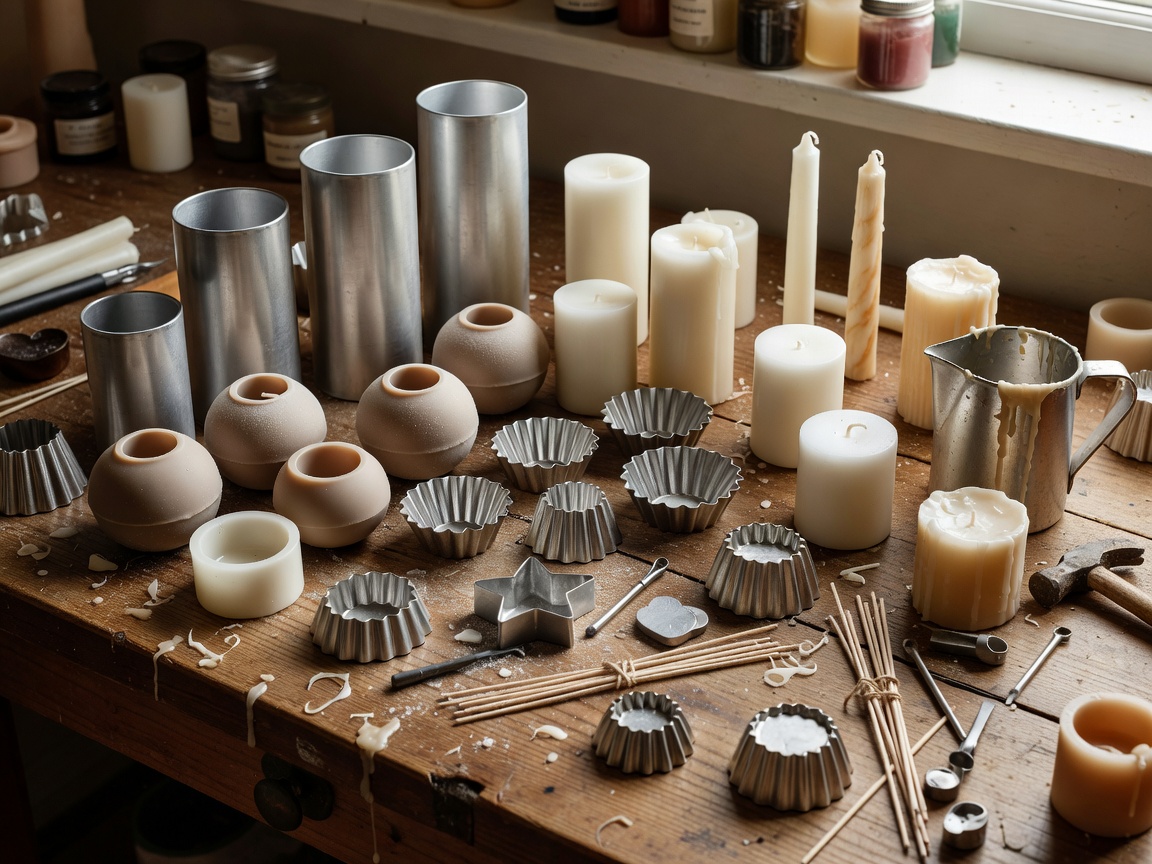
Candle-making methods are easiest to compare by the shape they produce and the support that shape needs. Container candles rely on a vessel. Pillars stand independently. Tapers are narrow, elongated forms. Molded candles take the geometry of a mold, while dipped and rolled candles build or shape material in distinct ways. Each method has different demands for equipment, consistency and surface finish.
Choose the form before the method
A container candle is formed inside a compatible vessel. The container supports the wax, so the finished candle does not need the same rigidity as a free-standing pillar. Vessel choice affects appearance, heat behavior and use. It must be intended for candle use and paired with a suitable wax and wick system. This approach suits studios producing repeatable objects in small batches, although the vessel adds cost, storage needs and compatibility checks.
A pillar candle is designed to stand on its own. Its wax must retain the shape after release from a mold or other forming process. Pillars can be simple cylinders or more complex sculptural forms. The method requires attention to mold geometry, release, surface quality and stable placement. Compared with containers, pillars remove the vessel variable but make the wax’s structural behavior more visible.
Tapers are slender candles made for holders. Their narrow profile calls for consistent dimensions and a base that fits the intended support. Dipping is one established route to a taper; molds can also produce straight, repeatable forms. A taper’s proportions, stiffness and fit matter as much as surface appearance.
Molded, dipped and rolled construction
Molded candles take their exterior shape from a reusable or single-use mold. This can provide repeatability, crisp edges and complex geometry. Molds require cleaning, storage and inspection. Fine details may be difficult to release cleanly, and a mold’s dimensions constrain the finished object. For a small studio, molding can make a distinctive shape practical, but the method needs a reliable system for keeping molds organized and checking each result.
Hand-dipped candles are built through repeated additions of wax around a wick. Each pass contributes material and changes the candle’s diameter. The method can create a softly layered, handmade profile, but uniformity depends on controlled repetition and a steady workflow. Dipping has a long history in household and workshop candle production, yet contemporary makers may use it for deliberately varied forms rather than factory-like sameness. Safe equipment, suitable ventilation and manufacturer guidance remain essential.
Rolled candles are formed from pliable sheets, commonly beeswax sheets with a patterned surface. The sheet is wrapped around a wick to create a spiral or layered profile. Rolling avoids a poured mold, and the material’s texture remains visible. Sheet thickness, alignment and pressure influence the finished shape. It is a relatively direct method for simple forms, but it offers fewer options for complex geometry and depends on the characteristics of the sheet wax.
Layering and decorative surfaces
Layered construction uses distinct wax areas or separate components to create bands, blocks or embedded forms. Layers can differ in color or material, but compatibility matters. Different wax formulations may contract or adhere differently. A deliberate transition can be part of the design; an unstable join is a defect. Small studios should document material combinations and assess the finished candle as a complete system.
Surface techniques include carving, texturing, polishing and adding a contrasting outer layer. Decoration can be applied during forming or after the main shape is established. The method affects detail, durability and repeatability. A carved pattern is tactile but may vary from piece to piece. A smooth molded surface is easier to reproduce but can show imperfections clearly. Decorative additions must remain suitable for the candle’s intended use and must not introduce unsafe combustible materials.
Finishing covers more than appearance. It includes checking the base, wick placement, edges, surface, labeling and documented product information. The aim is an object that matches its intended construction, not a cosmetic cover for inconsistent production.
Comparison for a small studio
- Container: vessel supports the wax; useful for repeatable batches; requires vessel and wick compatibility checks.
- Pillar: free-standing form; broad design range; needs appropriate structural wax and controlled geometry.
- Taper: slender, holder-based form; efficient to repeat; dimensions and holder fit require attention.
- Molded: consistent shape potential; supports complex forms; mold care and release quality take time.
- Dipped: visible layered character; flexible small-batch method; uniformity depends on a repeatable routine.
- Rolled: textured sheet construction; little forming equipment; limited to shapes the sheet can wrap.
Selection criteria
Start with the intended form, then consider the wax, wick, equipment, surface target, batch size and available storage. Ask whether the shape must stand independently, fit a vessel or sit in a holder. Decide whether the design benefits from natural variation or needs close visual consistency. Compare the cleaning and maintenance load alongside the forming method. Keep written records when changing materials or dimensions. For any candle intended to burn, use suitable components and responsible testing practices. Follow supplier instructions; do not assume that a method proven with one formulation transfers unchanged to another.